



Have you ever wondered what would happen if banks were hacked, internet services suddenly went down, or the personal data of millions of users was leaked in a single moment?
The answer is simple: a digital crisis that could impact the economy of an entire nation.
This is exactly why cybersecurity has become one of the most critical pillars of modern national security. Today, cybersecurity is no longer just a technical field—it is a strategic necessity for governments, businesses, and individuals alike. Egypt is no exception. In fact, the country has made significant progress over the past two decades, building a stronger cybersecurity ecosystem capable of addressing the growing challenges of the digital era.
As digital transformation continues to accelerate, cybersecurity has become essential for protecting critical infrastructure, financial institutions, government services, and citizens’ data. Egypt recognized the importance of this field early on and embarked on a long journey of development to establish a solid cybersecurity foundation.
The Beginning of Cybersecurity in Egypt?
The first signs of cybersecurity awareness in Egypt emerged with the introduction of the internet in the late 1990s and early 2000s. At that time, the primary focus was on adopting technology rather than securing it. As internet usage expanded, the country began facing basic cyber threats, including viruses, website defacements, and simple hacking attempts.
During this period, there was no specialized national authority responsible for protecting Egypt’s digital space. Organizations relied heavily on imported security solutions without a comprehensive national cybersecurity strategy.
In 2004, Egypt’s Ministry of Communications and Information Technology (MCIT) took a more structured approach toward digital development. As cyberattacks became increasingly common worldwide, Egypt started recognizing cybersecurity as a national priority and began laying the foundations for a more secure digital environment.
The Evolution of Cybersecurity in Egypt?
Phase One: Foundation and Awareness (2005 – 2015):
This phase represented the initial building stage of cybersecurity in Egypt and focused primarily on understanding cyber threats before implementing large-scale solutions.
Key developments included:
- Increased awareness of major global cyberattacks such as ILOVEYOU and later WannaCry.
- Creation of specialized security teams within major sectors such as banking and telecommunications.
- Introduction of basic information security concepts in Egyptian universities.
- Establishment of incident response capabilities, including Computer Emergency Response Teams (CERTs).Characteristics of this phase:
Characteristics of this phase:
- Relatively early-stage and reactive.
- Dependent on isolated organizational efforts.
- Focused on responding to incidents rather than preventing them.
Phase Two: Regulation and Governance (2016 – 2020):
This period marked a major turning point in Egypt’s cybersecurity journey.
Key developments included:
- The issuance of Egypt’s Cybercrime Law in 2018.
- The strengthening of the Supreme Cybersecurity Council to oversee national cybersecurity strategies.
- The introduction of cybersecurity and data protection policies across government institutions.
- Increased focus on protecting national digital infrastructure and government databases.
What changed?
- A shift from fragmented efforts to organized national strategies.
- Legal frameworks to combat cybercrime.
- Recognition of cybersecurity as an integrated ecosystem rather than isolated technical measures.
Phase Three: Professionalization and Expansion (2021 – Present):
During this phase, Egypt began transitioning from a technology consumer to a contributor within the cybersecurity ecosystem.
Major developments include:
- The launch of digital transformation initiatives such as Digital Egypt.
- Training programs aimed at preparing thousands of young professionals for cybersecurity careers.
- The growth of Capture The Flag (CTF) competitions and cybersecurity communities.
- Increased demand for cybersecurity professionals both locally and internationally.
- Strategic partnerships with global technology and cybersecurity companies.
One of the most important transformations has been the shift toward ethical hacking and offensive security practices. Egyptian researchers and security professionals are increasingly contributing to vulnerability discovery, penetration testing, and international cybersecurity projects while working remotely with global organizations.
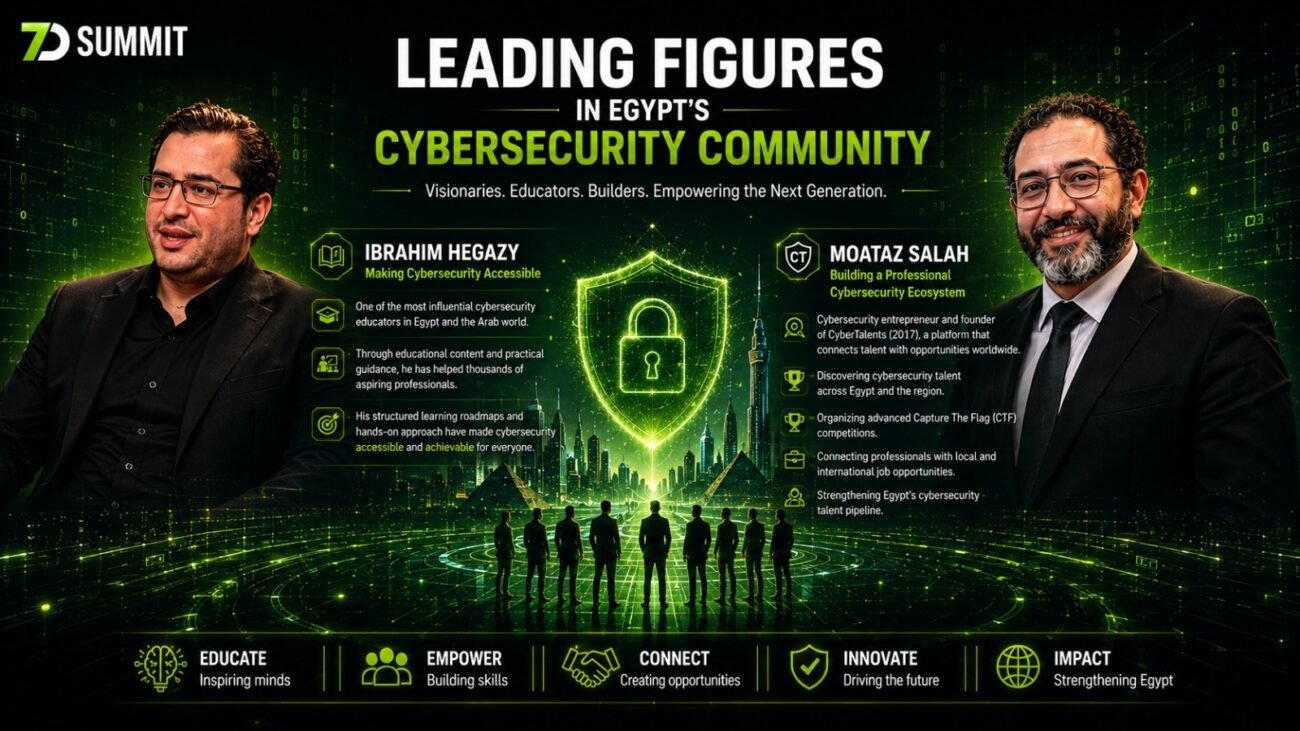
Leading Figures in Egypt’s Cybersecurity Community?
Ibrahim Hegazy – Making Cybersecurity Accessible:
Ibrahim Hegazy is considered one of the most influential cybersecurity educators in Egypt and the Arab world. Through educational content and practical guidance, he has helped thousands of aspiring professionals enter the cybersecurity field.
His structured learning roadmaps and hands-on approach have transformed cybersecurity from a seemingly complex specialty into an accessible and achievable career path for many young Egyptians.
Moataz Salah – Building a Professional Cybersecurity Ecosystem:
Moataz Salah is one of Egypt’s most prominent cybersecurity entrepreneurs and the founder of CyberTalents, a platform established in 2017 to identify, train, and connect cybersecurity talent with employers worldwide.
CyberTalents has played a significant role in:
- Discovering cybersecurity talent across Egypt and the region.
- Organizing advanced Capture The Flag (CTF) competitions.
- Connecting professionals with local and international job opportunities.
- Strengthening Egypt’s cybersecurity talent pipeline.
Its continued growth reflects the increasing maturity of Egypt’s cybersecurity sector.
Key Institutions and Organizations Supporting Cybersecurity?
Several organizations have played a vital role in strengthening Egypt’s cybersecurity ecosystem:
EG-CERT:
Egypt’s national Computer Emergency Response Team provides around-the-clock support for managing cyber incidents and responding to emerging threats.
The Supreme Cybersecurity Council:
Established to develop cybersecurity strategies and coordinate national efforts to protect critical digital infrastructure.
Private Sector Security Companies:
A growing number of cybersecurity firms contribute to awareness, consulting, penetration testing, managed security services, and workforce development across Egypt.
Together, these organizations have helped build an integrated cybersecurity ecosystem that combines education, implementation, innovation, and incident response.
Universities Leading Cybersecurity in Egypt Education
The American University in Cairo (AUC):
AUC is one of Egypt’s strongest institutions in technology and cybersecurity education.
Key contributions include:
- Advanced programs in computer science, cybersecurity, and data analytics.
- Strategic partnerships with global technology leaders such as Microsoft and Google.
- Modern cybersecurity laboratories that simulate real-world cyberattacks.
- Strong support for research in artificial intelligence and digital security.
Egypt University of Informatics (EUI):
The Egypt University of Informatics is one of the country’s newest and most specialized institutions dedicated to future technologies.
Its contributions include:
- Specialized degree programs in Cybersecurity, Artificial Intelligence, and Game Development.
- International collaborations with universities such as Purdue University.
- State-of-the-art technology labs and innovation environments.
- Direct support for Egypt’s digital economy and future workforce.
The Role of 7D Summit Mansoura and 7D Summit Delta in Supporting Cybersecurity?
As Egypt’s cybersecurity ecosystem continues to grow, community-driven initiatives have become increasingly important in raising awareness and connecting young professionals with industry opportunities.
Among the most notable initiatives are 7D Summit Mansoura and 7D Summit Delta, which actively support technology, innovation, entrepreneurship, and cybersecurity awareness across the Delta region.
These events provide a platform for students, professionals, entrepreneurs, and technology enthusiasts to engage with industry experts, explore emerging cybersecurity trends, and understand the growing importance of digital security in today’s economy.
By bringing together leaders from technology, business, and education sectors, 7D Summit Mansoura and 7D Summit Delta contribute to developing a stronger cybersecurity culture in Egypt and inspire the next generation of cybersecurity professionals.
Their commitment to knowledge sharing, innovation, and digital transformation aligns closely with Egypt’s broader vision of building a secure and resilient digital future.
Conclusion:
The growth of cybersecurity in Egypt is the result of combined efforts from individuals, educational institutions, government entities, and private-sector organizations. Influential figures such as Ibrahim Hegazy and Moataz Salah have helped spread knowledge and build professional communities, while institutions and companies have provided the infrastructure necessary for sustainable growth.
Today, Egypt is producing a new generation of cybersecurity professionals capable of competing on regional and international levels. With continued investment in education, innovation, and community initiatives such as 7D Summit Mansoura and 7D Summit Delta, the future of cybersecurity in Egypt looks increasingly promising.